
Figure 1: Heed the call, halfling
This moment—early 2026—is a particularly well-suited time in history to start self-hosting applications and rely on your own infrastructure. Whether in a local homelab or your own cloud deployment, the tools to build out personal environments have been getting better over time. The future looks a little shaky, though, so now is your moment! Increasing hardware costs have started to bloat the price of getting started and we’re staring the down barrel of drastically variable software quality as large language model (LLM) adoption grows (for better or worse)1.
My point is: if you’ve flirted with the idea in the past, we may be at peak conditions for taking the plunge, and I’ll explain why.
So: what kind of improvements have arrived in recent history that make the transition to self-hosted applications appealing now?
Not Your Grandparent’s Hardware

Figure 2: peak performance
Hardware has become cheaper, sure.
But beyond price alone, better form factors are compelling as well: the debut of the Raspberry Pi years ago meant that you could ssh into a fully-fledged server the size of a credit card in your closet.
That’s a much more tenable situation than 1U of rack space in your garage.
Not in the mood to be responsible for an SD card or hard drive in your house failing? Free (or nearly-free) pricing tiers in the major public clouds have become almost suspiciously affordable. I’ve operated some of my own infrastructure on the Oracle Free Tier for multiple years successfully and the gratis resources still don’t feel real at times2.
For the self-hosting curious who might ask,
How can I possibly operate compute resources that could compare to what major tech companies can provide?
The answer is: you don’t need to. Running a modest collection of applications to do things like read RSS feeds or manage media can fit very comfortably into consumer hardware specifications3. You need datacenters to host GMail for everyone on earth, but you only need one small Linux box to run a very significant portion of your digital life.
…or Your Uncle’s PHP App
Applications you can run yourself have become wonderfully mature and the catalog of solutions is vast. Whereas the blogging solutions of yesteryear included Wordpress and a handful of marginal competitors, you can choose from an almost limitless collection of either fully-fledged engines or static site generators from whatever language and ecosystem you’re comfortable with.

Figure 3: google what is a pod
I’d run out of room listing what you can self-host. Photo collections. Password managers. Digital document management. That isn’t even a half-complete list of what I run myself and I use most of those every single day.
In 2026 most (not all) of the operational headaches that come along with actually deploying applications are starting to fade, too.
No longer do you need to install a Linux package and configure a bunch of /etc files over ssh.
A docker-compose file usually packages up every dependency including running your database4.
Greybeards and Clankers
Self-hosting can be scary and that’s why having experienced advice can really help lower the barrier to entry. Two bodies of experience are ripe for utility: the existing corpus of blog posts from operators already doing it, and (carefully curated!) advice from LLMs (ironically, often sourced from those same blog posts).
Homelabbers and self-hosters have been doing this for a long time and blogging prolifically about it. You can find tremendous resources about any sort of infrastructure you want! Maybe you want to run in the cloud rather than your closet or use FreeBSD instead of Linux. Your reading options abound and, critically, from real people who can inform you about what works well and what doesn’t.
And if disaster strikes, you have a fairly competent colleague to consult with if you want to open up ChatGPT or Claude.
You don’t need to debug why you can’t reach your application at port :8080 alone, let the robots help.
The Coming Leviathan
Okay, if we’ve gradually built up this cathedral of technology to facilitate excellence in self-hosting options, why is now the best time instead of a few decades down the road? Is there a compelling reason to… wait?
Incumbent Rot
This image is an oracle:
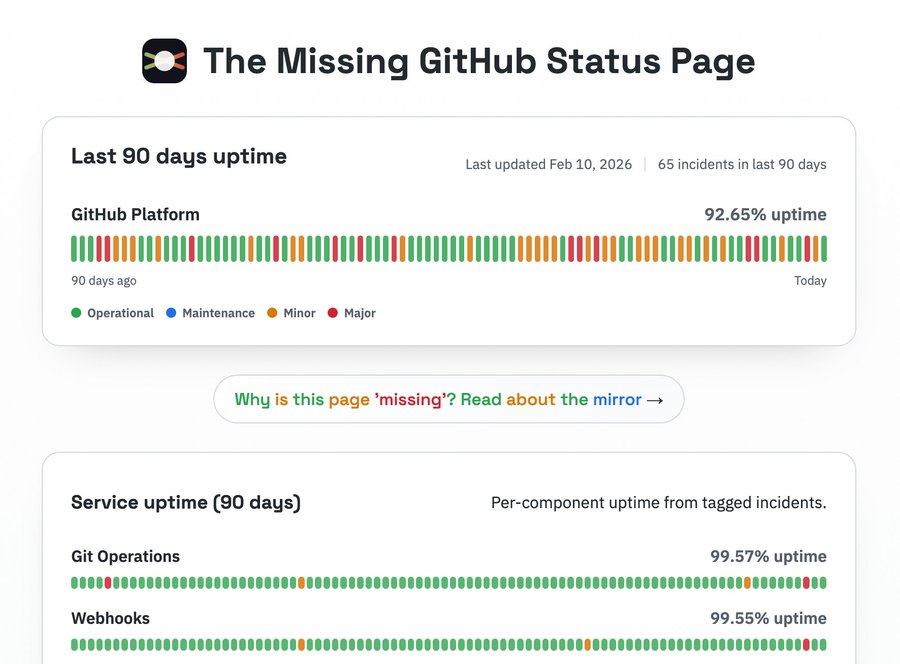
As shocking as it is to see a professionally-operated service with one nine of availability, the entropic rot of incumbent services is too big to ignore now. I cite GitHub here as an example, but you can throw a dart in a dark room and hit other examples.
- Microsoft can’t reliably improve Windows any more.
- Commercial developers have given up writing good software.
Your inner skeptic bemoans:
But how am I supposed to operate services any better if those are professionals?
Answer: you don’t have to. GitHub and its peers are catering to hundreds (thousands?) of use cases, across every cohort of developers, and trying to appease shareholders at the same time. Every dongle they superglue onto their existing product is a liability; an added source of friction that complects their overall operations.
It helps that would-be replacements for services like GitHub are actually in a really solid place right now. Solutions like Forgejo will take you far.
Hardware Uncertainty

Figure 4: my childrens’ college fund
During peak crypto, finding affordable graphics cards was a nightmare. Rather than abating, demand has only increased as LLMs continue to take off and other types of hardware are being caught in the wake.
Maybe the situation will improve. I have no crystal ball. But we can make judgments based upon the data in front of us, and memory prices in particular are a blaring klaxon of warning. As vendors actively pull out of consumer markets, options are literally vanishing as I write this post.
Free tiers in public clouds subsidized by big players are still viable, but even modest paid tiers for singular virtual private servers won’t be immune to hardware prices for long. My thesis is that now is the primest of times to purchase and hold onto computing assets. Even single-board ARM computers are extraordinarily capable!
Through Source Code Darkly
I don’t have a religious affiliation when it comes to AI1, but there’s one argument that isn’t really ambiguous:
- The barrier to entry for creating software is much lower
- Therefore, we’ll see more software (of all types of quality, good and bad)
Choosing well when it comes to running software was already more of an art than a science and the situation is going to become even more muddy as we’re flooded with many new projects that were coded with or without vibes. As the concentration of highly polished software becomes more diluted, it’ll become harder to pluck the gems out of the dross.
Starting now puts you in a good position to select from self-hosting projects that are well-established and with proven track records.
Who is Thy Master?

Figure 5: The eye gazes upon our Jira board
I’m going to be careful here: imagine the outgroup you hate most wielding unrighteous political power to strong-arm a service to give up your information. Better yet: imagine a company running that service adopting the ideological bend of the outgroup you hate the most. Now they’re using your data for whatever they want and training AI models to, I don’t know, hunt kittens with drones.
Even if one among many of the services you use today is aligned with your values, there is absolutely nothing holding them back from collapsing in on themselves like a dying star and reversing course down the road. The harsh truth is that there aren’t any guarantees about this because the only entity consistently aligned with you is… yourself.
The fortunate among us haven’t lived through this experience, but many have. Speaking personally: Microsoft bought and then shuttered Wunderlist. Sourceforge went to shit. The death of Google Reader has traumatized millions (billions?)
There and Back Again

Figure 6: Why shouldn’t I self-host my password manager?
What if I’ve convinced you? Where do you go next?
My advice would be two-fold:
- Decide on whether you want to run a virtual private server somewhere or buy your own hardware and do it.
- Choose one application you’d like to run (inspiration abounds).
This sets you on the path for setting up your own server with a concrete goal in mind. The sheer breadth of options can be daunting, but don’t waver: this is a great opportunity to exercise your agency and make some big decisions.
Do it for data sovereignty. Do it for continuity of the capabilities that are important to you.
Do it because an internet rando told you to.
Footnotes:
Look, I’m not in either extreme of the AI/LLM camp. But my point here is that you can sling hideous slop or finely-tuned code.
You don’t need to host your server on cheap-o free tiers; a $5 VPS is very capable.
I’m intentionally choosing my words here: some services, in particular hosting your own large language models (LLMs), emphatically do not work in low-resource environments. You’re welcome to splurge on GPUs if you want, but that’s not congruent with a moderately-priced homelab.
The enlightened among us, of course, run services the True Way.